A stock market simulator is one of the best ways for students to learn how investing works: they pick real companies, build a portfolio with virtual money, and watch the results play out in the real market — without risking a cent. Here are the best free options for 2026, whether you're a teacher planning a class competition or a student who wants to learn on your own.
Quick picks
- Best for teacher-run class contests: HowTheMarketWorks
- Best structured school program: The Stock Market Game (SIFMA Foundation)
- Best for learning on your phone: Three Investeers
- Best for older students who want options and crypto: Wall Street Survivor
- Best-known web simulator: Investopedia Simulator
Why students should use a stock market simulator
Most people never learn how the stock market works until they have real money on the line — and the first lessons can be expensive. A simulator flips that order. Students get to:
- Learn by doing: placing a trade teaches more than reading about one.
- Make mistakes safely: panic-selling or chasing a hot stock costs virtual money, not savings.
- Connect the market to the news: earnings reports and headlines suddenly matter to their portfolio.
- Build real financial literacy: diversification, risk and compounding become concrete.
We have seen how those mistakes look at scale. In our study of 800,000 practice trades, three trades in ten were closed within a minute, and the trades people left alone did far better than the ones they kept fiddling with. It makes a good classroom discussion, and the lesson costs nothing in a simulator.
1. HowTheMarketWorks — best for classroom contests
HowTheMarketWorks is a free, ad-supported virtual trading platform aimed at K–12 classrooms. Teachers can create a private contest for their class, set the contest dates, choose the starting cash and adjust trading rules, then assign from a library of more than 50 investing and personal finance lessons. Teacher reports make it easy to track how each student is doing.
- Cost: free
- What students trade: stocks, ETFs, mutual funds and bonds
- Starting cash: $100,000 in virtual money
- Best for: teachers who want full control over a class competition
According to HowTheMarketWorks, it is used by more than 10,000 teachers and 475,000 students every year.
2. The Stock Market Game — best structured school program
Run by the SIFMA Foundation since 1977, The Stock Market Game is the classic school investing program. Students usually work in teams, managing a virtual $100,000 portfolio and researching real stocks, bonds and mutual funds. Sessions can run from several weeks to a full school year, and the program comes with standards-aligned lessons for teachers.
- Cost: available at no cost or low cost, depending on your region
- Grades: 4–12, plus post-secondary learners
- Format: team-based sessions organized through schools
- Best for: schools that want a structured, curriculum-backed program
3. Three Investeers — best for learning on your phone
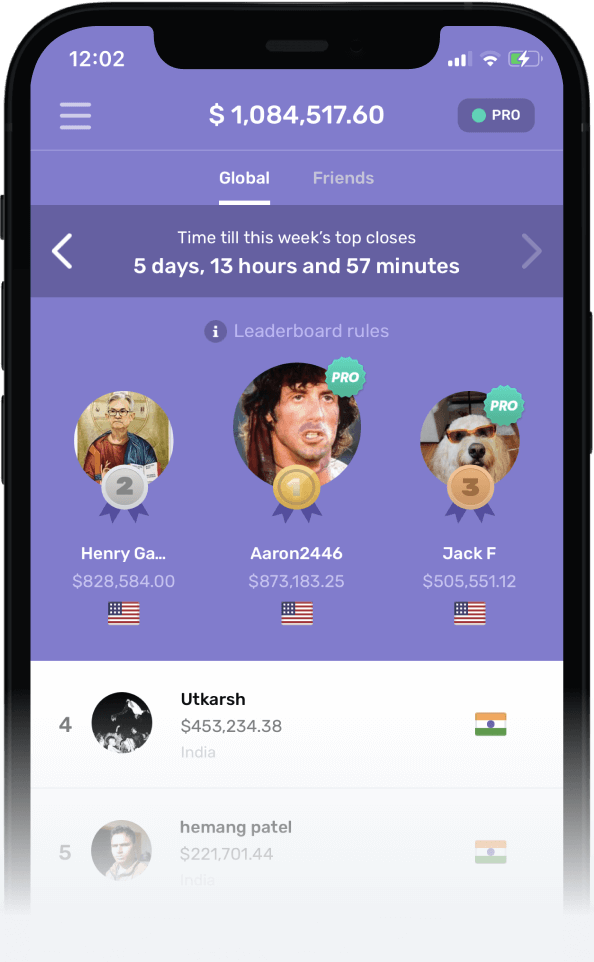
Three Investeers is a free stock market simulator app for iOS, Android and the web that pairs virtual trading with an interactive trading school. Instead of only placing trades, students work through a 39-chapter trading crash course, practice chart patterns with quizzes, and then apply what they learned in the simulator.
- Cost: free, with an optional PRO upgrade
- What students trade: stocks, forex and index funds with virtual money
- Starting cash: $100,000 in virtual money, or $500,000 with PRO
- Learning tools: a built-in trading course, quizzes and a chart-pattern cheat sheet
- Competition: weekly global leaderboard plus a Friends leaderboard for competing with classmates
- Age rating: 4+ on the App Store, where it's rated 4.8 stars
- Best for: students who want to learn at their own pace, on their own phone


4. Wall Street Survivor — best for older students
Wall Street Survivor combines investing courses with a free paper-trading account. It offers a wider range of assets than most classroom tools, which suits high school seniors and college students who want to explore options or crypto. Anyone can create a stock contest and invite friends to compete.
- Cost: free account
- What students trade: stocks, ETFs, options and cryptocurrency
- Starting cash: $100,000 in virtual money
- Best for: older students and self-directed learners
5. Investopedia Simulator — best-known web simulator
Investopedia Simulator is one of the most recognized free stock simulators. It covers more than 6,000 stocks on the NYSE and Nasdaq, plus ETFs and options, and students can trade solo or join games to compete. The main drawback for students is that there is no mobile app — it runs in a web browser. We cover its strengths and weaknesses in detail in our Investopedia Simulator review.
- Cost: free
- What students trade: US stocks, ETFs and options
- Best for: students who mainly use a laptop or Chromebook
How to choose the right simulator for students
- Who's in charge? For a graded class competition, pick a platform with teacher controls (HowTheMarketWorks or The Stock Market Game). For independent learning, an app is easier.
- Which devices do students use? Phone-first students need a real app; Chromebook classrooms can use any web simulator.
- How much teaching is built in? Lessons and quizzes turn a game into actual understanding.
- How complex should it be? Stocks and ETFs are plenty for most students; options and crypto suit older learners.
- Cost: every option in this guide can be used for free or at low cost.
How to run a stock market challenge in class
- Set a clear timeframe — four to eight weeks gives prices enough time to move.
- Start with a research assignment: each student or team picks companies and writes one sentence on why.
- Add rules that teach diversification, such as a maximum share of the portfolio in any single stock.
- Check in weekly and connect portfolio moves to real news headlines.
- Reward the reasoning, not just the return. A lucky bet shouldn't beat a well-researched portfolio in the final grade.